
In Switzerland's wine-producing regions, which include Valais, Vaud, German-speaking Switzerland, Geneva, Ticino and the Three-Lakes region, over 2,500 winegrowers cultivate 14,569 hectares of vineyards.
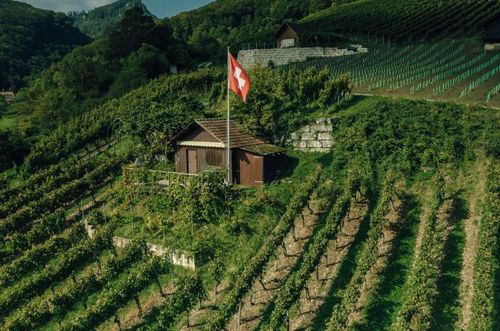
The special relief of the Swiss vineyards leads to viticulture on a human scale, where the winemaker's hand is the most important tool in helping the grapes to ripen.
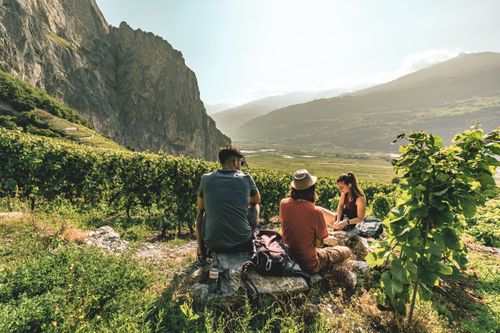
Switzerland offers numerous wine tourism destinations and activities in the heart of the Alps. A wide variety of landscapes and grape varieties ensure exciting experiences.
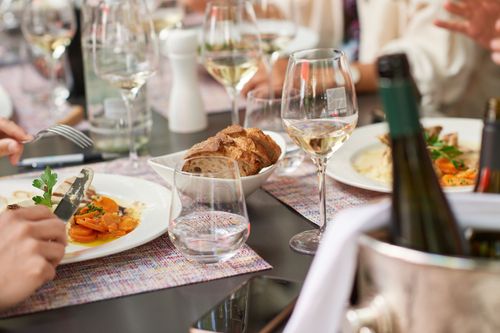
Pairing wine and food doesn't have to be complicated. We show how the right wine can perfectly round off a dish.
From the grapevine to the wine glass: discover fascinating insights about wine, learn technical terms, and deepen your knowledge with our wine courses.
The Grape Odyssey: a journey from Geneva to Visperterminen
By Marc Checkley
Geneva: The Beginning of the Journey
Your journey should begin in Geneva, where the city sprawl soon gives way to vineyards and villages. Satigny is the natural opening chapter, with by-appointment tastings at Jean-Michel Novelle, whose range includes several expressions of Savagnin alongside his Iconique Gamay and Pinot Noir. Another thoughtful stop is Domaine des Bonnettes in Lully, run by Francesca and Dominique Maigre. If you want someone else to do the navigating, Geneva’s e-TukTuk tour by TaxiBike offers a playful first sip of the landscape.
La Côte: Rolling Hills and Local Discoveries
Then head east along the Lémanic arc into the rolling hills of La Côte. Near Nyon, the Malak’off Gourmet stroll offers a self-guided ramble; and Domaine La Capitaine offers tastings from its distinctive blue bottles. In Luins, Cave Treyblanc pairs its wines with small local bites. If time is short, make for La Maison des Vins de La Côte in Mont-sur-Rolle, where more than 80 local winemakers are represented. Here, a Savagnin Blanc from Les Frères Dutruy sits alongside a Servagnin from Les Trois Terres — a reminder that similar names can definitely mean different stories. Servagnin is not Savagnin, but an old Pinot Noir selection linked with Morges for more than 600 years.
Féchy and Lavaux: Historic Vineyards Above the Lake
For an insightful pause, stop in Féchy at Domaine La Colombe (reservation recommended). Laura Paccot’s Amédée Savagnin Blanc fits beautifully into this route, while Curzilles, a co-planted white blend, speaks of an ancient time in viticulture: the vineyard ensemble. Lunch nearby at Auberge de Féchy, where the wine list makes it easy to lose track of time.
East of Lausanne are the regal terraces of Lavaux. The UNESCO-listed region towers above Lake Geneva, with many paths to wander through and over. Cycling tours can be arranged with Bikapa or hosted walks with Walk & Wine are possible, though the gradients should not be underestimated. If your glutes can handle it, high above Epesses, Domaine Gaillard & Fils (closed on Sunday) offers tastings and a Savagnin d’Epesses that is bright, racy and mineral-edged — a counterpoint to their vivacious Galotta. Sleep in Cully at Hotel Lavaux or Auberge de la Gare at Grandvaux.
Chablais: A Borderland Wine Region
Beyond Montreux, and Château de Chillon is Chablais, a true borderland wine region. In Yvorne, the slopes still carry the memory of the great landslide of 1584, which reshaped the terrain and revealed ancient gravelly soils. At Château Maison Blanche, Grand Cru Chasselas, Pinot Noir and Savagnin Blanc display the patchwork of glacial soils here. Contact Martin Suardet to visit the cellar.
Valais: Where Savagnin Becomes Païen
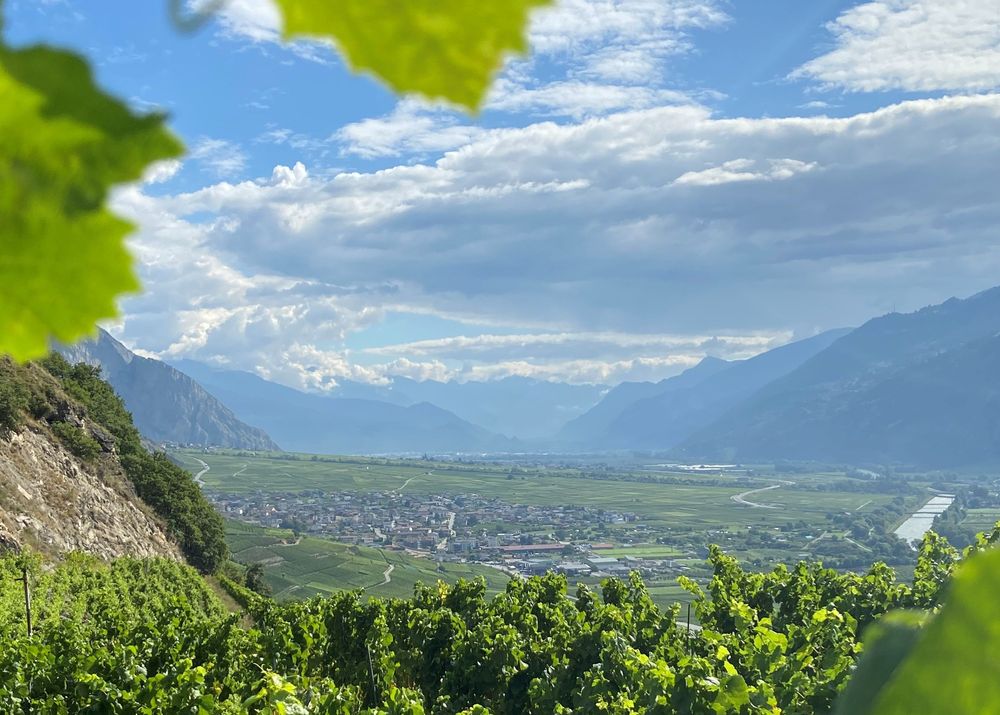
Cross the Rhône and the wine language begins to shift. Valais is Switzerland’s largest wine-producing region and also its driest; here Chasselas becomes Fendant, and Savagnin becomes Païen. The name is commonly linked to the “pagans” — the ancient pre-Christian tribes that once dwelled here. It is an evocative name for a grape that has meandered through time and place.
At Martigny, taste Païen and other memorable wines from Christophe Abbet, nicknamed “the wizard of Martigny”. For a local table, book Restaurant Les Touristes. From here, continue to Fully for a drink on the terrace at Fol'terres Bar, or a walk through Petite Arvine country, home to biodynamic pioneer Marie-Thérèse Chappaz (reservation essential), or nearby Cave des Amandiers.
Climb the ramparts of the medieval village Saillon and take in the Rhône valley from above. The Vignes de Farinet includes the world’s smallest registered vineyard, just 1.67 square metres. Currently under the custodianship of the Dalai Lama, it is symbolic and uniquely Valaisan. The Bains de Saillon makes an excellent stop to dip, recharge, or stay the night.
Sion and Sierre: Wine, Culture and Alpine Views
Further east, St-Pierre-de-Clages, offers another rewarding wine chapter. The area - long associated with the Johannisberg (Sylvaner) grape - is home to the Boven family’s Cave Ardévaz and to Daniel Magliocco & Fils, whose Païen, Hermitage and Syrah have real local pull. If travelling by bike, divert to the quiet Rhône river trail towards Sion. Here you can visit the ancient castles of Sion (tours available by donation), indulge in varied wine experiences at Celliers de Sion, or drift across Europe’s largest subterranean lake at St-Léonard.
Beyond Sierre, Païen morphs into Heida and French gives way to the local dialect Walliserdeutsch. Château de Villa is an essential stop: œnothèque, Sensorama, restaurant and Valais crash course in one, with hundreds of regional bottles and a signature raclette feast. Nearby in Miège, Sandrine Caloz brings her own signature to the vines, with biodiverse vineyards, grazing sheep and wines that feel distinctly personal. Her Mouton Caloz, made from Gamaret, Cabernet Franc, Syrah, and Pinot Noir grapes, is a local favourite. In Salgesch, stay among the vines at Domaines Chevaliers, or choose the wine cellar-themed rooms at Hotel Arkanum.
Visperterminen: The Final Ascent
The final ascent is the ultimate reward. Above Visp, the vineyards of Visperterminen climb from around 650 to 1,150 metres, among the highest in Europe. Here Heida is no longer a synonym but a local emblem. The Visperterminen vineyard hike, running from May to October (book online), follows the historic Beitra bisse, a 600-year-old irrigation channel, with views towards the Bietschhorn and Matterhorn. Stop for lunch and a guided tasting at multi-awarded St. Jodern Kellerei, before descending back to Visp.
A Swiss Wine Odyssey
Whether by train, bike, car, bus or stubborn legs, this grape odyssey is worth your time. From lake to Alpine valley, French to German, rolling slopes to ancient stone terraces, it offers sights, smells - and tastings - that distill the Swiss wine experience. Call it Savagnin, Païen, or Heida, it’s different by name, yet linked by nature and stories in the glass.
Related events
Related Articles
All the news about Swiss wines and exclusive reports.
To visit our site, you must be of legal drinking age in your country of residence.